Whitewater group logo
Services

Design & Engineering Services

Home > Design & Engineering Services
High-risk water systems under increasing pressure
Regulated and mission-critical industries depend on water and wastewater systems that must perform reliably, continuously, and in full compliance with evolving standards. Many facilities operate infrastructure originally designed for lower demand, different regulatory frameworks, or shorter asset lifecycles. As production intensifies and quality requirements tighten, these legacy systems are increasingly exposed as points of operational and compliance risk.

Organisations face a compound challenge. Regulatory expectations continue to rise across GMP, environmental discharge, and sustainability performance, while tolerance for downtime shrinks. Upgrades must often be delivered within constrained footprints, live production environments, and fixed validation windows. Poor visibility of system performance, limited redundancy, and fragmented ownership between design, construction, and operation further increase risk.

Any intervention must therefore balance technical rigour with practical delivery. Solutions need to integrate with existing processes, support future capacity and flexibility, and demonstrate measurable performance outcomes. The cost of failure is not theoretical: production interruptions, audit findings, reputational damage, and long-term operational inefficiency are all direct consequences of systems that are not engineered with these pressures in mind.

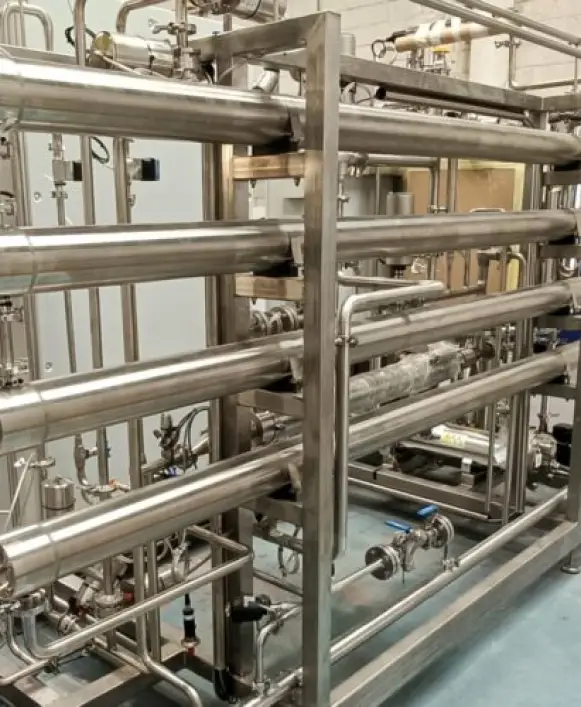
A stainless steel industrial piping and filtration system mounted on a metal frame structure inside a processing facility. The system consists of multiple horizontal pipes arranged in parallel tiers across five or six levels, supported by vertical stainless steel uprights. Various sanitary fittings, clamps, valves, and connectors join the pipes at multiple points. A cylindrical inline filter or membrane housing is visible on the right side of the lower section. The lower portion of the system features additional piping with manual valves, pressure gauges, and flow control components. The floor beneath is a clean blue-gray epoxy or tiled surface. Additional piping and equipment can be seen in the background, along with a wooden panel or wall section. The polished, sanitary-grade stainless steel construction suggests this is part of a pharmaceutical, dairy, beverage, or food processing operation, possibly a pasteurization, filtration, or heat exchange system
MEASURABLE IMPACT

Engineering that delivers measurable value

Regulatory confidence

Systems designed and delivered to meet GMP, environmental, and industry standards, reducing compliance risk and audit exposure.

Operational resilience

Improved reliability and redundancy reduce unplanned downtime and protect critical production processes.

Programme certainty

Roles are well defined and outcomes matter. Responsibility is matched with trust, enabling engineers to see the direct results of their work.

Sustainable outcomes

Efficient designs lower water consumption, energy use, and environmental impact across the asset lifecycle.
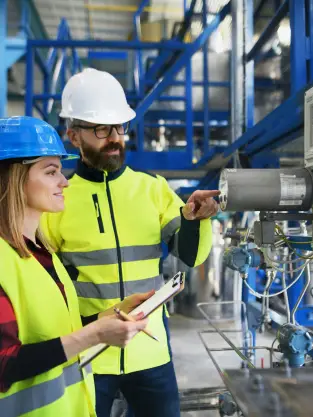
A male industrial engineer or site supervisor walking through a factory or processing plant while multitasking. He is wearing a white hard hat, a high-visibility yellow-green safety vest with reflective silver stripes, and a light blue dress shirt underneath. He has a dark beard and is holding a mobile phone to his right ear while carrying a clipboard or folder in his left hand, looking down at it as he walks. Behind him, a complex array of industrial equipment is visible, including metal pipes, conduits, wiring, and a diamond-plate metal platform or walkway. A metal ladder or stairway railing is visible to his left. The background is slightly blurred, emphasizing the worker in the foreground. The setting suggests a modern manufacturing, processing, or utility plant environment.

Related Sectors

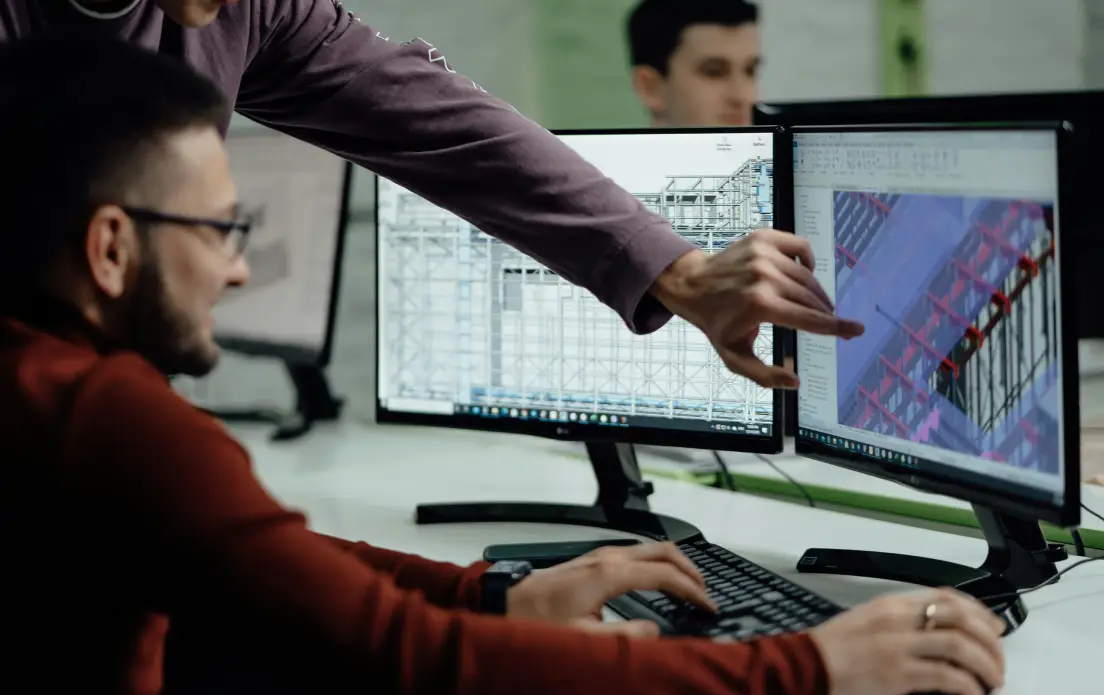
Two male engineers or designers collaborating at a workstation with dual monitors. The man in the foreground is seated, wearing glasses and a dark red sweater, with his hands on the keyboard. A colleague standing behind him in a dark purple shirt is pointing at one of the screens. The monitors display detailed 3D structural engineering or architectural models, showing what appears to be steel framework and building components in CAD software. The setting is a modern office environment
Case Study

Delivering complex systems under pressure

Whitewater Group was appointed to provide full lifecycle engineering support, from early feasibility and concept development through detailed design, installation, commissioning, and validation. The solution centred on a modular water purification system designed to meet current GMP requirements while allowing phased expansion over time.

Close collaboration with site stakeholders ensured alignment with production schedules and quality requirements. Installation and tie-ins were carefully planned and executed during agreed shutdown windows. Control systems were upgraded to provide improved monitoring, alarm management, and operational resilience. All documentation, testing, and validation activities were delivered in line with regulatory expectations.
Whitewater Group demonstrated strong technical leadership throughout the project. Their understanding of regulated environments and ability to deliver complex upgrades within a live facility gave us confidence at every stage. The result is a robust, future ready system that supports both compliance and production goals.
Contact us

Speak to an expert today

Get in touch for precise guidance from specialists who understand operational demands and regulatory pressures, delivering support that keeps your water systems efficient, compliant and resilient.
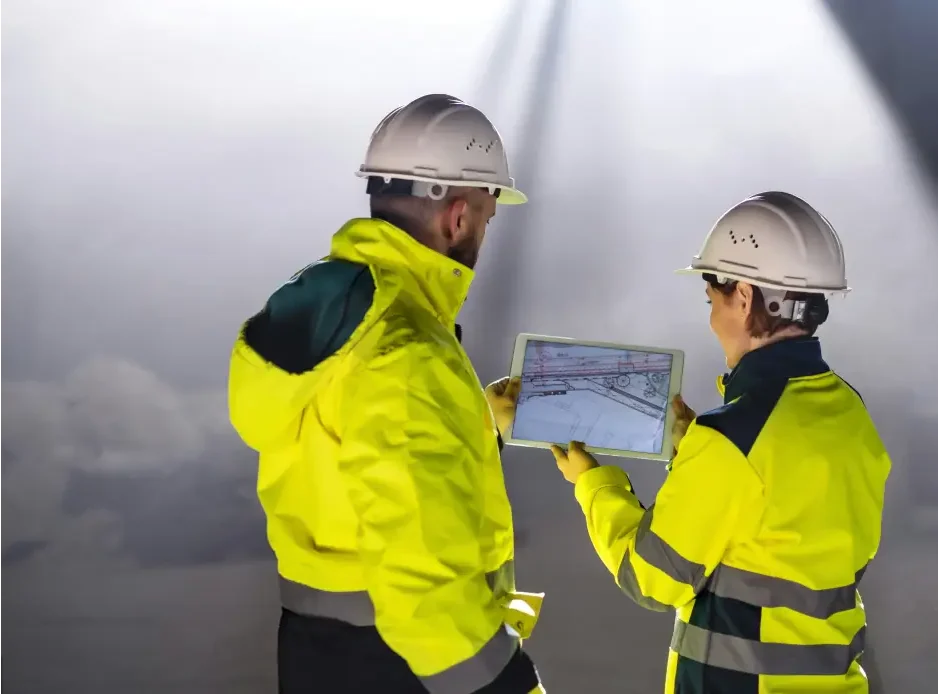
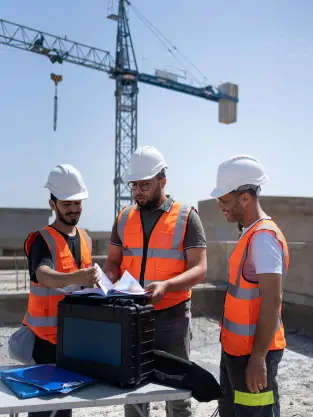
A man and a woman wearing high vis jackets and hard hats are looking at computer tablet
Copyright © 2026. All rights reserved.
Designed by TOTEM